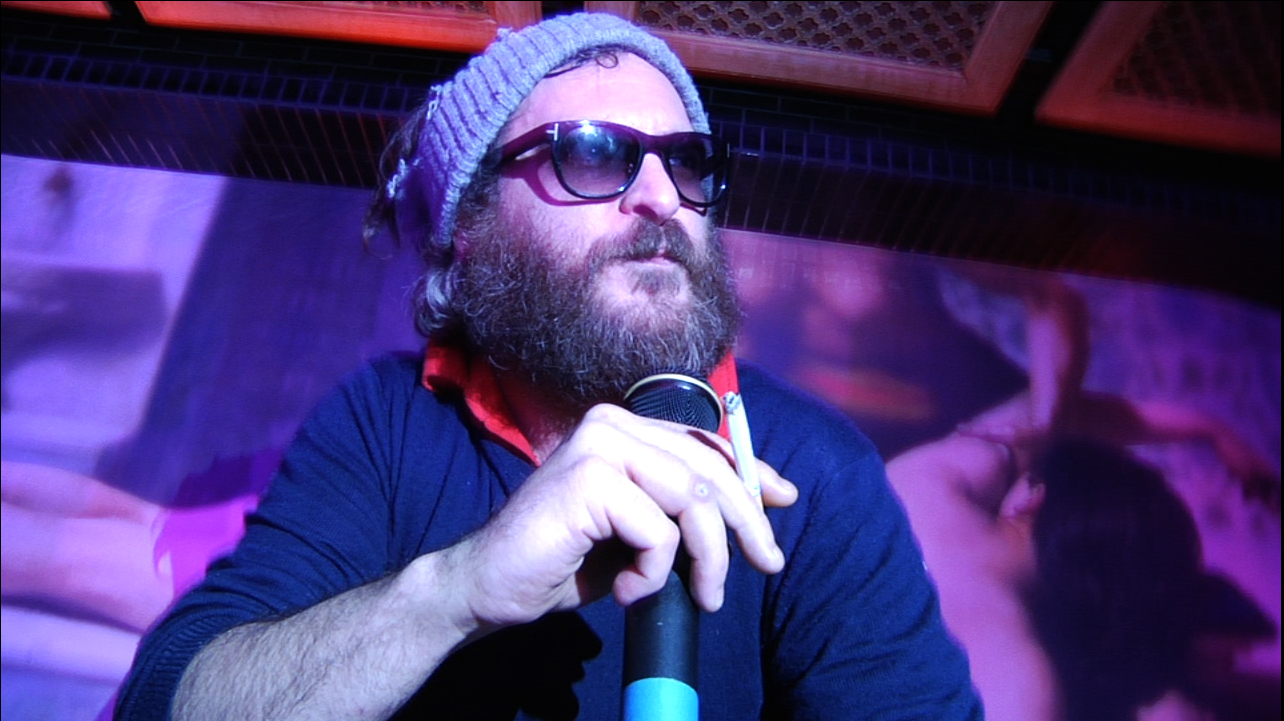
Friday, November 19, 2010

Arcade Fire

My online news story on Arcade Fire can be found at Exclaim.ca

Win Butler Sheds More Light on Arcade Fire's "Expiration Date"

Win Butler Sheds More Light on Arcade Fire's "Expiration Date"
By Andrea Warner

It's been a big year for Arcade Fire. The Suburbs, the band's third album, debuted at No. 1 on the Billboard charts in August, and lead singer Win Butler immediate freaked out the masses with his Spin magazine quote about "pop being a young man's game," saying he couldn't see doing this in another ten years. But as Butler recently explained to Exclaim!, people like to blow things out of proportion.

"People take stuff like that pretty out of context," he says. "I think what I mean is that I can't really see us doing exactly what we do indefinitely. Once you lose that connection to the songs, I don't think there's really any point to doing it exactly the same way."

The physicality of Arcade Fire's live shows have won them legions of adoring fans, but it's that very factor that Butler's alluding to.

"It's not like there's an expiration date on doing it, but it is like being an athlete," Butler explains. "People stop playing hockey at a certain age. You can't be getting punched in the face forever."

Now Butler's looking back at the year that's passed, though one foot's already planted in the future.

Butler admits, "2010's a big blur. When I'm writing the date on a cheque, I still have to always check the year. This next year, I'm really hoping we'll do a bunch of writing this winter and break up the touring cycle a little bit. For me, the greatest thrill in the world is the first time you play a new song and bringing a new song into the world. I'm really excited to get into that head space again.

"We're writing all the time. If I get a couple days off, we've been kind of taking little chunks of time off in between tours, and usually the first couple days I just sleep all day and it's kind of like this recovery period. Then by day three I'm like, 'Okay, I'm bored now. Let's play music.' It's nice to still be bored."

The Suburbs is out now on the band's own Sonovox records in Canada.

Thursday, November 11, 2010

Dan Mangan

My feature on Dan Mangan appears in this week's WE.

Dan Mangan: “I feel like I wrote 100 terrible songs before I wrote anything that was worth keeping around.”
Credit: supplied

Dan in real life

By Andrea Warner

Dan Mangan knows plenty of people were blindsided by the critical acclaim and popularity of his second album, 2009’s Nice, Nice, Very Nice. Suddenly, the 27-year-old Vancouver singer-songwriter was virtually inescapable, on radio and in print. But in reality, Mangan’s been toiling at his craft for 10 years — essentially, this city’s version of an overnight success story.

“I can see that to someone just hearing my name, [my success] would seem very sudden,” Mangan says with a laugh, over the phone from his Kitsilano home. “But it’s the same with anything. By the time there’s a really hip, successful restaurant that everyone knows about, it’s been there for six years, or by the time you’re a really great plumber with tons of referrals... you’ve been at it for six to eight years.”

Mangan’s comparisons are perfectly in keeping with his reputation for being confident yet humble, with a good-natured streak of self-deprecation. These qualities have also helped shape his sound and his storyteller lyrics, though Mangan admits that developing his own musical identity was a lengthy process. “It took me a long time to really figure out what my voice was and feel like myself inside of the songwriting and performing,” he says. “I think for the first number of years anyone is a musician, they just emulate their heroes... I feel like I wrote 100 terrible songs before I wrote anything that was worth keeping around.”

Following the break-up of his high school band, Mangan played around town for a few years before deciding the solo route was his best option. He laughingly refers to the experience of recording his 2003 demos as “a humbling process,” after which he embarked on six to eight months of touring, every year for almost five years. Often it was just him, his train pass, a guitar, and his luggage. “I did tours through Europe, the States, across Canada, even Australia — and, you know, just barely scraping by, going further and further into debt,” he says. “But I always had this blind optimism, this naive confidence that if I kept going, the ball would start rolling downhill as opposed to being pushed uphill.”

Mangan’s first glimpse of success was breaking even on his debut album, Postcards & Daydreaming. He then decided to go for broke, extending his line of credit to record Nice, Nice, Very Nice. The result? A string of sold-out dates, an extended tour, awards, and a coveted spot on the Polaris Prize shortlist. And after years of struggling alone, he’s now signed to Arts & Crafts, longtime home to Broken Social Scene, Feist, Stars, and other indie-rock giants. It’s a move that means he can continue to stay true to his roots.

“I grappled with the idea of moving to Toronto for ages and ages, and always thought that eventually I’d have to,” Mangan admits. “I know tons of musicians who have all, one by one, moved to Toronto or Montreal... [Signing] to Arts & Crafts, which is based in Toronto, was a big sigh of relief, like, ‘Okay, I don’t need to go anywhere.’ They’re on the ground fighting for me in Toronto, so I can just relax in my temperate, beautiful, lovely city that I adore to no end.”

The affection is mutual. Hometown support has helped Mangan from open-mic nights to this week’s two sold-out shows at the Vogue, and his long-held dream of performing at the Orpheum is poised to become reality. And, come December, he’s set to begin recording his third album. According to Mangan, moments like these feel simultaneously earned, phenomenal, and bewildering — just how Vancouver likes its “overnight” success stories.

Dan Mangan performs Nov. 11 & 13 at Vogue Theatre (918 Granville), 8pm. Sold out.

Tuesday, November 9, 2010

Due Date

My review of Due Date appears online at westender.com

DUE DATE

Starring Robert Downey Jr., Zach Galifianakis
Directed by Todd Phillips

The road-trip movie has been done to death, and yet with the right ingredients, two people confined to a compact space and forced to work out their issues can be great entertainment. It’s territory director Todd Phillips has mined all too frequently, with varying results, and his latest addition to the canon lands with a thud somewhere between two of his previous efforts, The Hangover and Road Trip.

Peter (Robert Downey Jr.) and Ethan (Zach Galifianakis) are total opposites who, of course, are thrown together through a series of unbelievable and ridiculous circumstances. The former is a straight-laced, tightly wound architect trying to get home to California for the birth of his child. Ethan is a flaky pot-head actor headed to Hollywood to try to make it big, carrying his recently deceased father’s ashes in a coffee tin in one hand and his French bulldog, Sonny, in the other. They both end up on the U.S. government’s No-Fly List and are forced to travel cross-country together. Hijinks ensue, as does the push-pull between Peter and Ethan as they plant the seeds for the inevitable friendship that blooms out of cinematic conflict.

Part of what prevents Due Date from triumphing over its tired plot conventions is its main characters. From the outset, Peter and Ethan are both fairly annoying dicks, thus negating the surface differences between them that are supposed to be the primary joke. And while there are a few hilarious moments, there’s a mean-spirited undercurrent perpetuating Due Date’s humour that falls a bit flat.

The movie’s advantage, though, is the somewhat inspired pairing of Downey and Galifianakis. They have a believable tension that gives way to a few genuinely touching scenes in which you may find yourself overcome with the sensation of actual tears. It’s director Phillips’s one new trick here, and it’s a clever one that staves off Due Date’s early expiration. —AW

Thursday, November 4, 2010

Megamind

My review of Megamind appears in this week's WE and online at westender.com

megamind-latestfullposter-fullsize

MEGAMIND

Starring Will Ferrell, Brad Pitt, Tina Fey
Directed by Tom McGrath

Following in the spindly-legged footsteps of Steve Carrell’s evil Russian genius from Despicable Me (an unexpected summer blockbuster) comes Will Ferrell as the titular anti-hero of the delightfully clever Megamind.

Megamind is a blue, bulbous-headed alien sent to Earth as a baby after his home planet implodes. His path to evil is paved by circumstance: he lands in a “home for the criminally gifted” and is raised by prison inmates. Conversely, another baby boy simultaneously launched from space lands in a wealthy, loving home and becomes Metro Man (Brad Pitt), Megamind’s lifelong rival, a square-jawed superhero adored by the citizens of Metrocity.

After Megamind realizes his dream and defeats Metro Man, he faces an existential crisis: What’s his purpose? To break out of his depression, he hits on the idea of transforming a down-and-out regular citizen, Hal (Jonah Hill), into a new superhero foil for him to fight. Also reinvigorating our anti-hero is his budding love for TV reporter Roxanne Ritchi (Tina Fey).

The plan, of course, backfires, and Megamind must assume the role of the hero when his creation goes from good guy to thug. Under the glossy, wickedly funny veneer of sight gags and jokes both low- and high-brow. Megamind fully embraces its deeper philosophical theme of nurture versus nature. There’s also a tremendous amount of heart packed into a dense 90 minutes. Artistically, the flick’s animation is expressive and lively wrought, while the well-executed 3D effects integrate seamlessly into the action.
If 2010 is any indication, a new sub-genre of animated film is putting conventional cartoon heroes on notice: the bad guys are in it to win it. —AW

Howl

My review of Howl appears in WE this week, and online at westender.com

James Franco (right) takes on the role of Beat poet Allen Ginsberg in the biopic, Howl.
Credit: Supplied


HOWL

Starring James Franco, Jon Hamm
Directed by Rob Epstein, Jeffrey Friedman

By all accounts, Beat poet Allen Ginsberg’s life was like his writing: rebellious, funny, and incisive. Howl, the highly anticipated quasi-biopic about the controversy surrounding Ginsberg’s most famous book of poems, attempts to pay tribute to its subject’s legacy. Unfortunately, it just can’t get past the roadblock that is its star, James Franco.

The story unfolds in non-linear fashion, bouncing between four distinct eras in the poet’s life: his student days at Columbia University; his debut live performance of “Howl” in 1955; the 1957 obscenity trial for his first published collection, Howl and Other Poems; and as the subject of an interview later in his life (the bulk of which narrates the film).

Franco’s take on the elder Ginsberg is restrained and relatively believable, unlike the hammy exuberance that threatens to derail the scenes surrounding the poet’s debut performance. Here, Franco seems to be doing an impression of Ginsberg, and a bad one at that. It doesn’t help that large sections of the actor’s reading are illustrated with an extended animated sequence. Poetry’s purpose is to evoke images. Someone else’s literal, visual translation is unnecessary and annoying.

It’s telling that the film’s most dynamic and interesting moments — the obscenity trial — don’t feature Franco at all. Instead, Jon Hamm and David Strathairn go toe-to-toe as opposing council, fully exposing the ridiculous nature of such censorship hearings. There’s an extra jolt of fun seeing the host of high-profile actors, from Jeff Daniels to Mary-Louise Parker, in cameos as experts testifying for or against Howl’s literary merit.

Ginsberg’s life is rich with cinematic possibility, but writers-directors Rob Epstein and Jeffrey Friedman sacrifice their subject for camera tricks and art-house indulgence that never feel genuine. If Ginsberg’s Howl was about a generation crying out, this Howl is a strangled whimper. —Andrea Warner

Wednesday, October 27, 2010

Death of arts equals the death of communities

My cover story for this week's WE tackles the double impact of arts funding cuts and city bureaucracy on communities and their public events.

Public Dreams Society’s Parade of Lost Souls is dying a slow death. Despite once drawing crowds of up to 30,000 costumed revellers, funding cuts mean organizers can only accommodate 1,500 participants this year.
Credit: Larissa Sayer

Buried Alive!

It’s been 14 months since the death knell first sounded. Arts organizations that had been promised three-year gaming grants found their funds frozen and money already guaranteed by the provincial government would be pulled back.

That was just the first hint that the sky was about to fall. Following the initial shockwave, the province then threatened to cut up to 90 per cent of its arts funding (that amount has since settled at around 50 per cent).

It’s been suggested that the death of arts equals the death of communities. If this proves true, Commercial Drive looks to become the first casualty.

Small organizations like Public Dreams Society (PDS) are experiencing the one-two punch of funding cuts and City bureaucracy around large-scale gatherings in public, outdoor spaces. The result: two of PDS’s biggest events — long-standing annual community tent poles of the Commercial Drive area — have either left the neighbourhood entirely (as is the case with Illuminares, the annual lantern festival that helped reinvigorate Trout Lake in the ‘90s, which was relocated inside W2 Storyeum last year) or, experienced massive downsizing, as with the once 30,000-strong Parade of Lost Souls.

It’s all been a slap in the face for PDS, an organization that has spent almost 25 years contributing to the Drive’s transformation into one of the city’s most desirable neighbourhoods.

“[2008’s Parade of Lost Souls] was incredible,” says Laura Grieco, PDS general manager. “They shut down Commercial Drive, there were DJs up and down the street, there was an incredible street party,” she recalls. For the first time, she says, it seemed just as many people were there to watch as they were to participate. But organizers didn’t get much of a chance to imagine how the Parade of Lost Souls could continue to evolve. In 2009, having experienced the first wave of provincial funding cuts, they received a further blow from the City, a combination that forced the cancellation of last year’s parade.

“We were to the point where we were advised by the City that if we were to do another event [of the size of 2008’s Parade of Lost Souls], the costs we’d be incurring for policing — they suggested that it would be comparable to what they would allocate to the [Celebration of Light]. So, that’s huge,” Grieco says.

Muriel Honey, manager of the Film & Special Events Office, denies that the City conveyed the costs would be comparable. “Any comparison between the Parade of Lost Souls and the Celebration of Light would have been made to illustrate the range of services required,” she says. “In no way are the costs of civic services the same for these two events.”

Indeed, the costs aren’t nearly the same. While PDS would be on the hook for its policing costs, the Celebration of Light is actually City-funded. (It’s one of only two annual City-funded events — the other being the Remembrance Day ceremony.) According to a 2001 City Council report, Tourism Vancouver made a compelling argument that the Celebration of Light (then called the Symphony of Fire) become a civic event, due to substantial economic and cultural benefits to the city. Council agreed to cover the City’s services costs, provided other sponsors cover the remainder.

Almost a decade later, the City is still footing their part of the bill, which includes reimbursing the Vancouver Police Department for its policing costs. According to financial statements released to WE from the VPD, the price of policing 2010’s Celebration of Light was $604,000. In 2009, the first year the Parade of Lost Souls was forced to cancel, it was $690,000. And in 2008, when the City was desperately trying to clamp down on embarrassments like public drunkeness, homophobic assaults, and stabbings, the tally was $719,000.

Those numbers are eerily similar to the amount spent on crowd control for the Granville Entertainment District. In fact, policing the chaos of Granville Street could conceivably be seen as a twice-weekly public event, since it involves street closures, large crowds, and a heavy police presence. The cost of policing the GED (referred to as year-round “Liquor Deployment” in the VPD reports) has risen from $552, 223 in 2006 to $723,946 in 2009.

Without the benefit of municipal subsidies, this year’s Parade of Lost Souls has been officially scrapped, much to the disappointment of fans who hoped the parade could pull through despite the odds. In its place, PDS has created the smaller-scale Secret Souls Walk. Rather than taking place outdoors in Grandview Park (which is currently under construction), the Britannia gym (maximum capacity 500) will serve as a family-friendly open house for crafting. Additionally, organizers have arranged guided and self-guided tours through different neighbourhood streets, the locations of which won’t be disclosed until the evening of the event (Saturday, Oct. 30). At most, PDS estimates it will be able to accommodate 1,000-1,500 people — a far cry from the 30,000 participants who attended the event two years ago.

According to Grieco, PDS lost $35,000 in gaming and arts council money. Through additional fundraising efforts they’ve raised some of that money back, but not nearly enough to fund the Parade of Lost Souls.

“This year’s budget is under $10,000,” Grieco says, estimating that the cost of a parade the size of 2008’s would be between $50,000 and $60,000. “It would be a lot easier for us to just move on and say we’re a victim of our own success. But we have so many people who are just such hardcore supporters and it’s so distinctive to Public Dreams and so distinctive to the city. There’s so much support for it. We thought, OK, we don’t have the money, but how can we not do this? We just have to make it smaller.”

NDP MLA Spencer Chandra Herbert, Opposition critic for tourism, culture, and the arts, spent years working with arts groups on community engagement and has seen firsthand what PDS events can offer the area.

“Art sparks dialogue, debate, discussion — all those things that make communities healthy,” he says. “If you chomp away at what little funds go towards those kinds of things, it becomes increasingly difficult to get people out of their homes, or out from in front of their TVs, to talk to their neighbours, to have a laugh together. Illuminares and Parade of Lost Souls... put the arts into the hands of everybody. It’s not top down, sit and hide in a darkened room and watch. You’re actually an art maker.”

Steve Duncan, a long-time resident of Commercial Drive and founder of The Drive Is Alive blog, is also concerned about his community’s future.

“It was a shame to see Parade of Lost Souls almost disappear last year,” he says. “That had a big impact and people certainly felt a hole. Now that it’s coming back and it’s not in the same capacity, I think people really are feeling it.”

Duncan himself moved to the Drive nine years ago because of the neighbourhood’s reputation as a burgeoning arts and culture hub — a reputation built partly on organizations like PDS using outdoor public space in inventive and interesting ways.

“I think that it becomes a little bit more like Yaletown or places like that where we don’t have as much happening outside,” he says. “We don’t have as many large community events. People get turned off by going [inside]. If the weather’s good, they want to stay outside, and Halloween’s kind of traditionally an outdoor activity. I think people will start to go other places and find other things to do.”

Approximately two weeks ago, the City and PDS met for a last-ditch planning meeting. The City offered to offset policing costs after the event ends at 9pm. Despite the offer, PDS still doesn’t have the budget to pay for the policing necessary for a circa-2008 parade.

“There’s the desire there on our part and on the City’s part to keep these events going, but it is really hard without the infrastructure,” Grieco says. “When you start having that eroded by government funding being cut, it puts you on that precipice where you go the safe route rather than the more risky route.”

Commercial Drive is not the only neighbourhood at risk of losing a beloved and iconic public event. Terry Hunter, artistic producer of the Downtown Eastside’s Heart of the City Festival, (Oct. 27-Nov. 7) has also taken a wait-and-see approach.

“We’re taking it one year at a time,” he says, trying to remain hopeful that the province and the City will recognize the necessity of investing in arts in order to build thriving communities.

“Art gives people a sense of meaning, engagement, and hope,” Hunter says. “It can give them a sense of empowerment. And, it increases the livability of a community.”

That is, perhaps, the most frustrating part for neighbourhood arts groups. No one seems to want to (or know how to) factor in the intrinsic value of events like Heart of the City, Illuminares, and Parade of Lost Souls when it comes to a neighbourhood’s ability to flourish or flounder.

“We’re not to be credited wholeheartedly,” Grieco says of neighbourhood arts groups. “It’s the community that came together and really reclaimed that space. But, real estate values go up and gentrification happens, and there’s good and bad aspects of that. These kind of cultural events add value to the neighbourhood, and I don’t know if across the board that value’s being recognized by key people. I’m not convinced that everybody’s getting that clear equation.”

Wednesday, October 20, 2010

Sweeney Todd

I highly recommend Fighting Chance Production's Sweeney Todd. My review's in this week's WE.

Alex McMorran and Cathy Wilmot strike a devil’s deal in Fighting Chance Productions’ Sweeney Todd: The Demon Barber of Fleet Street.
Credit: Supplied


Up-and-comer gets deliciously down and dirty

Since making its debut in January 2007, Fighting Chance Productions has evolved from fledgling musical-theatre company to youthful powerhouse, with memorable offerings like 2009’s Rent and a campy production of Forbidden Broadway. Now, just a few short months after mounting an acclaimed production of Hair, the little company that could makes a bold play for a spot among the theatre scene’s heavy hitters (Arts Club, Electric Company, Playhouse) — but on a fraction of the budget. With its production of Sweeney Todd: The Demon Barber of Fleet Street, it has scored its greatest triumph yet.

A gruesome tale of injustice, revenge, and blood-soaked madness, the Stephen Sondheim musical revolves around Sweeney Todd (Alex McMorran), an escaped convict who returns to London 15 years after being wrongfully imprisoned by the lecherous Judge Turpin (Arne Larsen). Todd returns to his former home above Mrs. Lovett’s (Cathy Wilmot) pie shop, where the pie-maker reveals that Todd’s wife went mad, took poison, and left their child, Johanna (Krista Gibbard), to be raised as the judge’s ward. Mrs. Lovett soon agrees to help Todd exact revenge on the judge, encouraging him to reopen his barber shop, thus kick-starting a ravenous murder spree and an ingenious, if revolting, method of disposing of the bodies.

Meanwhile, Johanna, now 16 years old, is a caged bird, locked away from society in Turpin’s house. From her window she catches the eye of Anthony (Chris Harvey), a boy incidentally indebted to Todd for saving his life, and they fall in love, much to Turpin’s chagrin. The old judge decides to marry Johanna, sparking a plot by the teens to escape his clutches. When it fails, Joanna is sent to an asylum.
Todd helps Anthony break her out, and subsequently lures Turpin back to his shop for a bloody climax, wherein all of the characters collide — some dead, some alive — in Mrs. Lovett’s basement.

Fittingly, McMorran and Wilmot command the audience’s attention at every turn. McMorran’s Todd has a crazed glee in his eyes; a hulking, haunted step; and a voice that sends shivers up the spine, especially when he’s reunited with his razors (“My Friends”) or recounting the horror that befell him at the hands of the judge (“The Barber and His Wife”). Wilmot neatly shifts from hilarious to hopeful, sharing her delusions about a future with Todd (“By the Sea”), followed by a heartbreakingly empty promise to protect her young ward, Toby (“Not While I’m Around”).

In addition to their individual performances, the duo are mesmerizing when they share the stage together, particularly during the hilariously grotesque “God, That’s Good!” They also amp up the sexual tension between their characters, adding depth to the depravity of their shared bloodlust.
Even the insta-romance between Anthony and Johanna, usually Sweeney Todd’s weakest element, gets a new lease on life. Harvey and Gibbard infuse their characters’ longing with a profound sense of urgency, elevating songs like “Kiss Me” from saccharine to substantive. Gibbard, particularly, is a revelation, hitting Sondheim’s difficult-to-sing syncopated notes with assured confidence.

Director (and Fighting Chance founding artistic director) Ryan Mooney challenges himself yet again with a small stage and an overflowing cast. And yet he has full control over the proceedings: the music, the set pieces (sparse and effective), and the actors move together in perfect synchronization under his watchful eye. His Sweeney Todd is a masterful marriage of music, melodrama, and the macabre. This young gun is blazing. Able to achieve so much with so little, Fighting Chance should have the bigger, more established theatre companies looking over their shoulders in admiration, for now, and with a little trepidation in the years to come.

Sweeney Todd: The Demon Barber of Fleet Street runs to Oct. 30 at Jericho Arts Centre (1675 Discovery), 8pm (Wed-Sat). 7:30pm (Tues). Tickets $20-$30 from FightingChanceProductions.ca.

Zooey Deschanel

My interview with Zooey Deschenal, actress/musician and one-half of She & Him, is this week's WE cover story.

“A lot of times people will just assume the guys write the songs and the girls sing them,” says Zooey Deschanel about She & Him, her collaboration with singer-songwriter M. Ward. In fact, she writes the duo’s music.
Credit: supplied


Zooey Deschanel takes control in her music

Her long dark hair, framing a pair of piercing blue eyes, has inspired the hipster-chic look of countless aspiring, awkwardly cute ingenues the world over. Her starring role in (500) Days of Summer can only be described — in part, at least — as a love letter to her innate adorableness. She’s married to indie-rocker Ben Gibbard of Death Cab for Cutie, and her parents named her after a J.D. Salinger character. She’s even the face of a U.S. ad campaign for cotton, for Christ’s sake. There need be no more evidence that Zooey Deschanel personifies “indie darling.”

And yet, there is. Deschanel — best known as an acclaimed actress with roles in Almost Famous, Elf, and Yes Man — is also one half of She & Him, the Americana-pop-folk duo she formed with singer-songwriter and guitarist M. Ward. The pair released their debut, Volume One, in 2008, garnering positive reviews and a sizeable audience for its mostly ’60s-inspired ditties about love and life. They’re now on tour supporting Volume Two, which was released in March of this year. And even though it’s two albums and almost three years later, Deschanel is still forced to correct people’s assumptions that Ward — who, in addition to recording under his own name, has been a part of indie-rock supergroup Monsters of Folk — writes She & Him’s songs. He doesn’t. This is Deschanel’s baby.

“People are confused because I don’t play on every song... but that doesn’t mean that I didn’t write them!” Deschanel laughs over the phone from her L.A. home. It’s a frustrated laugh, and she brings up the topic herself — evidence, perhaps, that this is a method of self-preservation.

“I guess I just have to take it as one of those weird things where I guess I’m flattered?” Deschanel jokes. “They think, ‘Wow, she couldn’t possibly have done this!’ I’ve talked to female friends of mine who are singers. A lot of times people will just assume the guys write the songs and the girls sing them — which, you know, Matt [Ward] produces the stuff and that’s a really important part of the process, and we’re all doing important things within the process, but I’m not just showing up and being a puppet. I am writing the music.

“And a lot of times people think I just write lyrics. I wouldn’t ever want to just write lyrics... I’m no Bob Dylan, you know what I mean? It’s not like [my] lyrics are amazing. It’s a whole package.”
Thanks to her lengthy acting career, Deschanel has built up a tough exterior that makes her capable of withstanding the cheap shots she’s required to take.

She claims she was nervous the first time she sent her music to Ward, but that she wasn’t really worried. “I thought the worst that could happen is that he doesn’t like them, and that’s not so terrible,” she says, matter-of-factly. When it’s suggested that plenty of other people might become wilting flowers when putting themselves and their music out into the world, Deschanel is firm in her conviction.

“If you’re going to be a creative person, you have to put yourself up for rejection a lot... You have to accept you’re not everybody’s cup of tea. And I think the more you work and the more output you give to the world and the more successful you are, the more people will hate you and the more people will love you. It’s very polarizing. Just being creative in general — people have strong opinions about you, and you can’t let that affect your view of yourself. You have to have confidence that’s unshakable at the core... but, you know, [you can’t be] so open that you just let it completely destroy you. It’s good to be a little tough.”

It’s that toughness, ultimately, that gives She & Him’s shiny, sincere sound enough substance to resonate with modern audiences. Deschanel’s lyrics have a hint of girl-power-style affirmation about them, a coy sense of humour that’s defiantly at odds with the innocence the songs’ melodies evoke.
The She & Him sound was largely influenced by Deschanel’s lifelong love of the Beach Boys. But her relationship to the classic American pop band goes beyond an affection for surfboards and brilliant harmonies — they were a lifeline to her native California throughout a childhood riddled with lengthy sojourns around the world, thanks to her father’s work as a cinematographer and director.

It’s telling that, though her music could have plenty of international influences, she ardently favours vintage Americana. “We’d listen to ‘Surfin’ USA’ just to hear — ’cause I’m from Pacific Palisades and it’s mentioned in the song. I was so homesick and we were so far away,” she recalls. “We didn’t have the Internet; it was the ’80s. There just wasn’t a lot of connection. We were in Yugoslavia and on this tropical island, and just places where there wasn’t even a hint... of the world we were from, just completely culturally the opposite. So, it was really important to me to just listen to this tape and hear the name of my hometown. I think to me, yeah, definitely travelling — more than it exposed me to other cultures, [it] made me realize how much I love where I’m from and how much I am distinctly Californian.”

Deschanel laughingly admits that she’s romanticized her home state to the point where nowhere else will do. But with one foot in Hollywood and one foot in the music world, there’s not much need for her to leave California. With the ongoing success of She & Him, and the self-chosen infrequency of her acting gigs, the inevitable question arises: Will the day come when music eclipses movies as top priority in her life?

“I’ve always been sort of a doer, you know? I just wanna do things. I don’t wanna sit around, I just want to do creative things,” Deschanel says. She talks for a few minutes about her love of movies — going to them and starring in them ­— but counters this by acknowledging that She & Him is a more satisfying creative experience. She likes the control she’s able to exert in the band, and working with a few trusted collaborators. She articulates her ambitions and restlessness, eventually winding her way to an answer that satisfies her. For now, at least.

“Doing movies, you’re compromising a lot,” she says. “Ultimately, an actor is meant to trust their director. Your job is to go on set and bring a perspective, but ultimately, the director’s the boss, and you have to be a real serious team player, which I can do, but it’s not my nature. If I had to choose, I’d probably choose writing music and performing music, because I’m doing all of it at once.”

She & Him play Sunday, Oct. 24 at the Orpheum Theatre (Seymour & Smithe), 6pm. Tickets $35 from Ticketmaster, Zulu, Red Cat, and Highlife.

Monday, October 18, 2010

Red

My review of Red appears in this week's WE.


RED

Directed by Robert Schwentke
Starring Bruce Willis, Mary Louise Parker, Helen Mirren


A comic-book adaptation catering to the over-40 crowd might not sound cool, but this newest addition to the over-stuffed graphic-novel film genre succeeds where others have failed. A grown-up action flick, Red layers laughs between the flying bullets and fierce blows.

The movie’s title stands for “Retired, Extremely Dangerous,” a code used to label former black-ops agents like Frank (Bruce Willis). His retirement is pure tedium, interrupted only by the bashful phone conversations with Sarah (Mary Louise Parker), the bureaucrat who processes the government pension cheques he tears up every few weeks, so he has an excuse to call her. When Frank’s house is suddenly shot to splinters by masked gunmen, he goes on the lam, dragging the reluctant Sarah along in an effort to protect her.

Frank regroups with his former covert team to topple his perceived nemesis, CIA agent William Cooper (Karl Urban), and take down the bad guys. The motley crew features Marvin (John Malkovich), a lethal, rightfully paranoid basket-case who suffers from flashbacks thanks to daily doses of LSD he was given as part of a CIA experiment; Victoria (Helen Mirren), a beautiful reservoir of icy calm who can fire machine guns without blinking; Joe (Morgan Freeman), a sly horn-dog suffering from stage-four cancer; and Ivan (Brian Cox), a former Russian spy who still carries a torch for Victoria.

The story unfolds in predictable shoot-‘em-up fashion, but Red’s draw is its strong cast, all of whom have great fun playing (mostly) against type. (Mirren and a machine gun? Brilliant!) And though this is a comic-book adaptation, there are no superheroes here, just plenty of delightfully implausible action sequences, sharp humour, and the visceral thrill of seeing actors dig in to elevate Red from merely decent to dangerously fun. —Andrea Warner

The Fantasticks

My review of The Fantasticks appears in this week's WE.

THE FANTASTIKS

The Fantasticks is the longest-running musical of all time. Staged Off Broadway for 42 years, from 1960 to 2002, it was revived in 2006 and continues on to this day. And yet, having finally seen this theatrical mainstay, in the form of Vancouver Playhouse’s season opener, the resounding question I’m left with is “Why?” Why has this trifling endeavour endured? Mediocrity, thy reward is ever-lasting life — at least on stage.

Loosely based on the Roman myth of Pyramus and Thisbe, the action centres around two supposedly star-crossed lovers. Luisa (Bree Greig) and Matt (Colin Sheen) are basking in the glow of what they think is forbidden love. In reality, their fathers, Hucklebee (Mark Burgess) and Bellomy (Andy Toth), have built a wall between their properties and staged a long-standing feud to coerce the pair into marriage (because teens can’t help but do the opposite of what they’re told).

As if these contrivances weren’t enough, the last step in the fathers’ plan is to facilitate a reconciliation between their families by employing dashing and devious Spaniard El Gallo (Steve Maddock) to fake-kidnap Luisa with his two hired guns, over-the-hill and over-the-top theatre actors Mortimer (Simon Bradbury) and Henry (Christopher Gaze). The hope is that Matt will fight for Luisa’s honour, thereby becoming her hero.

Despite the efforts of a worthy cast, the Playhouse’s production proves oddly lifeless and flat. The convoluted book and lyrics by Tom Jones don’t help the cause any, but a good part of the problem here is the odd staging. Most of the action is confined to a 10-by-10-foot raised space in front of a background littered with fascinating props (like a merry-go-round horse) that have absolutely no context. But the worst aspect — at least from my seat in tenth row, stage left — was poor lighting that left the actors in shadows no matter where they stood.

The production’s one bright spot is Gaze, whose hammy thespian character literally demands the spotlight every time he appears onstage. In addition to being well-lit, he steals every scene, and his scenery-chewing as a slightly loopy, aging Shakespearean actor earns the biggest laughs (the in-joke here being that Gaze is the founding artistic director of Bard on the Beach). The rest of the performances fail to stir much in the way of response, but that’s not necessarily the fault of the actors. The show’s lengthy Off Broadway success isn’t indicative of its musical superiority — rather the opposite. The Fantasticks is the theatrical equivalent of a Twinkie: Just because you can still eat it after five decades, that doesn’t mean you should.

The Fantasticks runs to Oct. 23 at Playhouse Theatre (Hamilton at Dunsmuir), 8pm. Matinees: Wed & Sat, 2pm. $32-$59 from 604-873-3311 and VancouverPlayhouse.com

Greece Does Grease

My review of Greece Does Grease appears in this week's WE.

Cass King (left) and Melody Mangler (right) sing and strip in the burlesque mash-up, Greece Does Grease.
Credit: Supplied


GREECE DOES GREASE

The Screaming Chicken Theatrical Society has played a huge part in establishing Vancouver’s thriving burlesque scene. With its latest show, Greece Does Grease, company founder and artistic director Melody Mangler conceived of and then achieved the seemingly impossible: a mostly successful marriage of Ancient Greek mythology and the music of stage-to-screen musical Grease and its sad-sack cinematic sequel, Grease 2.

There are no T-Birds but plenty of togas in this burlesque parody. The story mostly focuses on Persephone (Miss Fitt), the doted-on virgin daughter of Demeter (Cass King, of the musical duo the Wet Spots) and Zeus (Bernie Bombay), who falls for bad-boy Hades (Basil).

Of course, liberties are taken with the ancient texts (Persephone was actually kidnapped by Hades back in the day), and the all-too-familiar songs have been loosely rewritten to suit the onstage shenanigans. It’s fun, however, to hear Grease’s campy ’50s-style classics reformatted and juxtaposed against such overtly sexual content. Bombay, who gets huge laughs with his portrayal of Zeus as an unrepentant pervert, has great energy in his ode to narcissism, “Greek Lightning.” Mangler, as bad-girl Hecate, cranks up the heat to seduce Demeter in the sexy girl-on-girl number, “There Are Bad Things You Can Do.” But it’s King, as a heartbroken mother at the end of her rope, who steals the show with her phenomenal solo, “Hopelessly Devoted to Genocide.” Infused with pain, longing, and heart, it’s the highlight of the evening.

The production, though original and creative, isn’t without its flaws. The humour careens unevenly from ridiculous to erotic, with the provocative occasionally derailing into the juvenile. The story is often stuck in exposition where a song would better bring the audience up to speed. And some technical snafus still need attention, particularly the microphones, which amplify the sound to almost skull-splitting levels whenever there’s a confrontation or a chorus of nymphs (pretty much every five to 10 minutes). But Greece Does Grease is never short on enthusiasm, triple-threat skills, or skin — a trifecta few other stage productions dare attempt, much less attain.

Greece Does Grease runs to Oct. 16 at Waterfront Theatre (1412 Cartwright, Granville Island), 8:15pm. $23-$30 from BrownPaperTickets.com.

Thursday, October 7, 2010

The Park

I really loved Studio 58's The Park, and I think you will, too.

Over-earnest environmentalists fight off unscrupulous politicos and developers in Studio 58’s original musical, The Park.
Credit: submitted


Studio 58 pokes fun at Vancouver’s foibles

Writing a fully realized two-act musical in college takes hubris. Writing one that’s as winning and entertaining as The Park takes talent. The versatile young minds at Langara College’s Studio 58 have both.

Written by Benjamin Elliot, Anton Lipovetsky, and Hannah Johnson — all either students or recent graduates — The Park’s first incarnation was as part of last year’s STEW, Studio 58’s performance series of one-acts. Feedback was overwhelmingly positive, so the trio went back to work, fleshing out what is ultimately the quintessential love letter to Vancouver, albeit one that wholly recognizes and pokes fun at the city’s quirky characters and archetypes.

John (Joel Ballard) is a disgruntled parks worker who gets a pink slip after six thankless years on the job. In a moment of self-indulgent fury, he lets slimy millionaire Gabe (Dustin Freeland) talk him into signing a petition to turn Stanley Park into Stan Park, a concrete parking lot. But John’s also secretly in love with Geena (Amy Hall-Cummings), a fiercely aggressive environmental activist, and vows to help her with her own petition to stop the destruction of the park.

The three leads display versatility, good comic timing, and varying degrees of vocal prowess. Freeland’s a gifted scene stealer, but Ballard’s performance is quietly appealing. And the supporting cast has plenty of opportunity to step briefly and repeatedly into the spotlight. Although each has moments worth mentioning, Kendall Wright, who plays park supervisor Patricia, deserves singling out. On paper, Patricia is annoying, hyper-sexualized, and supremely melodramatic. Wright takes those qualities and skillfully ratchets them so far over the top that she somehow moves the character from grating to ingratiating.

The songs are clever, paying tribute to everything from Sondheim to AM ’70s gold. Opening number “Springtime Happening” is well-executed, kicking things off neatly, efficiently, and most importantly, entertainingly. The characters are briefly introduced, we get a sense of what’s to come, and the song lets us in on the tone of the ensuing two hours: humour mixed with hope. “Chicken Waltz” is hilariously violent but sweet, a tongue-in-cheek exaggeration of the crazy things we do for love, while “A to the Q to the Warium,” which features the juice-worshipping Vancouver “President,” is a great send-up of the city’s culture. Throughout, The Park’s style of gentle self-mockery proves endearing. The writers may make fun of their characters (and Vancouverites in general), but they never diminish them.

David Hudgens’s direction is lively and inventive, perfectly in keeping with Kayla Dunbar’s frisky but- fun choreography. The backing band, which includes Elliot, Lipovetsky, and drummer Spencer Shoening from local indie-rock band Said the Whale, keeps the momentum going. Taken together, the winning elements of The Park signal that a revolution is going on behind the classroom doors. Not content to merely produce the future faces of Vancouver theatre, by creating this homegrown musical and achieving a tricky balance of humour, heart, and social commentary, Studio 58 proves they are Vancouver theatre.

The Park runs to Oct. 17 at Studio 58 (100 W. 49th Ave.), 8pm. Tickets $10-$22 from 604-684-2787 and TicketsTonight.ca.

The Salteens

My interview with the Salteens' Scott Walker.

Scott Walker (front) has resurrected his long-absent band, the Salteens, with more than double the members but without any guitars.
Credit: Submitted

The Salteens scratch their seven-year itch

Seven years is a long time between albums. To wit: Not only did Facebook not exist when the Salteens, the Vancouver-based indie-pop group led by singer-songwriter Scott Walker, released its second album, 2003’s Let Go of Your Bad Days, neither did MySpace.

So, where did Walker & co. go? And how did they morph from a relatively traditional guitar-driven pop-rock band to the 10-piece chamber-pop collective that made the Salteens’ long-awaited third album, Grey Eyes?

I have a very soft spot for the Salteens — as, I’m sure, do many Vancouverites who are in their early thirties — so I’m happy you’re back.
Scott Walker: We talked about how... this record is so different, maybe it should have been a new band. Especially because we’re not teenagers — we never were — so the name’s getting sillier and sillier. But there’s still something about the aesthetic of what we’re doing, the group of people; we’re the same group of friends, still... It also seemed like the albums were natural progressions. The first album [2000’s Short-Term Memories] was more of A Hard Day’s Night — wait, I’m not going into a Beatles reference; that’s no good. (Laughs) The first record was very guitar-driven, and the second record we tried to incorporate more instruments, and this record it’s just all instruments — there are no guitars. We started the band as a bunch of music nerds trying to figure out how to play rock ’n’ roll, and maybe the less we play rock ’n’ roll, the better we’re getting.

What went on between the last album and this new one?
There was just a lot of growing up; a lot of the real-life things that happen take away from the time and energy you might have to be working on the things you might have been working on. We actually almost finished an entire album in that time span, but — ugh! — I just hit a writer’s block. The lyrics weren’t really all there, and the record just wasn’t coming together. And I’m kind of glad it all fell apart to some degree, because then we had to put it all back together.

Do you feel that this album is an accurate document of what was going on in the interim [during which Walker’s father died and his mother’s health declined due to Alzheimer’s]?
Yeah. I think lyrically it’s much more black-and-white. I used to be really obsessed with the grey area of relationships, constantly looking at two points of view and how do you know what’s right and what’s wrong... The band’s always been some kind of affirmation of trying to make life more interesting, or trying to do things that are more exciting or have more meaning, and that’s come under attack to some degree in my personal life. So, questioning myself and reasserting my position’s been an important thing for me.

Did you think at any point that you were done with music?
Yeah. It’s funny how you work a day job and you get home and you’re like, “Well, I could go out and make music or I could watch TV.” Now I know why people watch TV — they work all day and they’re tired, and it’s really easy to not try harder. But, ultimately, I realized that for those brief moments I was playing music, I was happier than when I was doing anything else, so that has to be there still.

Seven years is a long time and there have been some huge changes, be it in social media or technology or Canada’s place in the music industry.
I think any changes in technology, the music industry’s inherently closer to [them]. I don’t think they’re shocking or disarming. Bands and porn probably do more for how the Internet changes than anything else — and maybe people who make crafts at home.

The Salteens play Saturday, Oct. 9 at Biltmore Cabaret (395 Kingsway), 8pm. Tickets $10 from Ticketweb, Zulu, and Red Cat.

Wednesday, September 29, 2010

I'm Still Here

My review of I'm Still Here is in this week's WE.


I’M STILL HERE

Starring Joaquin Phoenix, Sean “P. Diddy” Combs
Directed by Casey Affleck


The cat came out of the bag two days prior to I’m Still Here’s Vancouver press screening. Confirming what many suspected after his infamous Late Night with David Letterman appearance two years ago, Joaquin Phoenix’s descent from respected actor to drug-addled wannabe rapper was all a hoax, captured on film by fellow actor (and brother-in-law) Casey Affleck and packaged as a faux-documentary that’s short on charm and long on self-indulgent wankery.

The mockumentary’s opening hints at its potential for clever social commentary: Phoenix making the press rounds, reminding the audience that famous people aren’t just making entertainment or art, but are subject to the relentless monotony of self-promotion. What unfolds from there is two hours of Phoenix fake-pontificating about the meaninglessness of everything (grand, sweeping, incoherent statements are Phoenix’s specialty here), spewing verbal abuse at his “friends,” snorting drugs, cavorting with prostitutes, and waxing fondly about “women’s butt holes.” The film’s central plot, with Phoenix desperately trying to get his terrible rap music heard by Sean “P. Diddy” Combs, is sort of amusing thanks to Combs’s performance. (Was he in on it, too? Probably. His bewildered reactions feel genuine, though.)

At best, I’m Still Here is high-octane performance art fueled by ego and self-importance that exposes society’s obsession with unravelling the celebrities we create. At worst, it’s a costly two-year in-joke that derails Phoenix and Affleck’s careers and personal lives, making the movie a mind-numbing, oh-so-meta circle of a self-fulfilling prophecy. —Andrea Warner


Let Me In

My review of Let Me In is in this week's WE.

LET ME IN

Starring Kodi Smitt-McPhee, Chloe Moretz
Directed by Matt Reeves


The titular difference between the exquisite 2008 Swedish film, Let the Right One In, and its American remake, Let Me In, is subtle but telling. Where the original tapped into the cruel beauty of vampires as metaphor for the everyday horrors of growing up, writer-director Matt Reeves’s version is Hollywood lite: metaphor-free and bereft of pesky nuance.

On the bright side, Let Me In couldn’t have better source material, which automatically elevates it well above most other unnecessary remakes. It also boasts performances by two powerful preteen leads. Owen (Kodi Smitt-McPhee) is a lonely 12-year-old kid ignored by his parents and bullied at school. When Abby (Kick-Ass’s Chloe Moretz) moves in next door, he thinks maybe he’s finally found a friend — even though she confesses she’s been 12 for “a very long time.” As their relationship progresses through a series of sweetly twee scenes — like their nightly ritual of communicating through their shared bedroom walls using Morse code — a string of unsolved murders leads straight to Abby’s door, and Owen’s bullies escalate their attacks, leading to a bloody climax.

The film starts strong thanks to cinematographer Greig Fraser, whose opening scenes are among the most creatively filmed in recent years, and Michael Giacchino’s score is reminiscent of the brilliant tension Wendy Carlos and Rachel Elkind crafted for horror classic The Shining. There are good things in Let Me In, but fans of the original will resent Reeves’s decision to forsake storytelling in favour of amping up the gore, thereby diluting — but not extinguishing — the film’s power. —Andrea Warner.

Grant Lawrence

My interview with Grant Lawrence, about his debut book Adventures in Solitude: What Not to Wear to a Nude Potluck and Other Stories from Desolation Sound, is in this week's WE.

Rocker and CBC Radio 3 host Grant Lawrence has added writer to his resume with his first book, Adventures in Solitude.
Credit: Submitted


Finding the Humour in Desolation Sound

Grant Lawrence threw up a lot as a kid. This is one of the first things you learn about the long-time CBC Radio 3 host and former lead singer of defunct Vancouver-based indie-rock band the Smugglers in his debut book, Adventures in Solitude: What Not to Wear to a Nude Potluck and Other Stories from Desolation Sound. The no-holds-barred memoir details Lawrence’s love-hate relationship with the titular enclave, a wild, secluded area of the Sunshine Coast where his family has spent their summers since his youth. Sitting in the sun at a picnic table in CBC Plaza, Lawrence spoke with WE about his first foray into writing.

WE: I’m a born-and-bred Vancouverite, yet your book is the first insight I’ve ever had into Desolation Sound.

Lawrence: That’s the weird thing about Desolation Sound. Very few people know anything about it, and its name is verboten! People don’t necessarily seek it out. There’s Clayoquot Sound or Nootka Sound or Howe Sound, and then there’s Desolation Sound. It sounds a bit frightening, and as you read in the book, there are frightening elements to it... It’s a bipolar place, which is fitting since it was never diagnosed, but it was possible that Captain Vancouver was bipolar, and a lot of the people up there are kind of bipolar. I swear, it’s like the island in Lost. (laughs)

So, the world’s possibly mentally compromised congregate there and find a home.

Yes, but to varying degrees of success. It could end in fiery suicide or years of summertime bliss.

Have you always written?

No, this is a new adventure. I’ve always wanted to be in the entertainment business, so I was in a band for a long time, and I do the radio thing. I always hoped I’d write a book someday, but I didn’t know what about or when I’d have the time. This one just kinda came out. It was part of the rediscovery of the place when I went back and thought, ‘How could I have ever hated this place? It’s really quite special.’ And once I started going up frequently as an adult, I realized that — I mean, there are characters everywhere in life, but the characters up there were so vibrant and on the edge on so many different levels, mentally and physically. I found all these stories on how everybody got to Desolation Sound, this bottleneck for those looking to escape or start over. I found all of that fascinating, and I just started writing.


That’s a good point about people looking to start fresh. Obviously, they have some pretty great stories to tell.

Yeah, and there’s kind of an outlaw vibe there; there is literally no authority. Every once in a while, a park ranger will come by because it’s a large marine park, the largest on the West Coast of Canada... Maybe once in a blue moon there’ll be a police officer down by the dock, the government wharf, but almost never. It’s interesting up there, where it’s kind of like ‘anything goes,’ and it’s a little bit Lord of the Flies, where there’s a tentative balance and everyone sort of has to behave and live by the rhythm of nature and not mess with each other’s shit.

Are you afraid of getting feedback from people whose stories you put down on paper?

A little bit. This is a fairly private place. I learned a lot about the words “truth” and “legend” and “myth” writing this book. There’s lots of history in the book as well, and I did tireless research. But when it came to writing anecdotes, whether it was the First Nations or just the local scallywag, everybody had a different version of what really happened. So, at a certain point, it just had to be — well, it’s my memoir, my memory. I guess I’m just picking the best version. There are some stories where I changed some elements, because this is an area I hold close to my heart, and as an artist I felt the need to profess my love for it. But I would hate that it [could have] any negative effect on anyone.

A release party for Adventures In Solitude: What Not to Wear to a Nude Potluck and Other Stories from Desolation Sound happens Thursday, Oct. 7 at the Museum of Vancouver (1100 Chestnut), 7pm. This free event features performances by singer-songwriter Jill Barber (Lawrence’s wife) and indie-rock band Said the Whale.

Thursday, September 23, 2010

Vancouver Film + TV Forum cover story

My cover story for WE on the Film + TV Forum features interviews with Vince Gilligan, the creator of Breaking Bad, Michael Schur, the co-creator of Parks and Recreation, and more.

A scene from the Emmy-winning TV series Breaking Bad. Its creator, Vince Gilligan,  is a panelist at the 25th annual  Vancouver Film + TV Forum.
A scene from the Emmy-winning TV series Breaking Bad. Its creator, Vince Gilligan, is a panelist at the 25th annual Vancouver Film + TV Forum.
Credit: supplied

COVER STORY: Insider Knowledge

Virtually every Vancouverite knows about the Vancouver International Film Festival, which launches its 29th edition Sept. 30. But mention its trade counterpart, the Vancouver Film + TV Forum (Sept. 28-Oct. 2), and the most likely response will be a distracted “Huh?”

Celebrating its 25th anniversary this year, the VFTF may be the best kept secret in town. Every year, a host of industry insiders — from directors to writers to producers — flocks to the four-day symposium, which offers an assortment of panels, workshops, and networking opportunities. Though the event caters primarily to hopefuls peddling a script or a project, it’s open to anyone who might be interested in getting the inside scoop from established Hollywood types and indie auteurs. And the increasingly high calibre of its special guests is just one sign that Vancouver’s position in the industry has evolved from a cheap location for cash-strapped projects to that of a major player on the international scene.

WE rounded up four very different participants to provide a sneak peak of this year’s VFTF: Michael Schur, the Emmy-winning writer and co-creator of Parks and Recreation; Vince Gilligan, the Peabody Award-winning creator of Breaking Bad; VFTF board member Michael Ghent; and writer-director-teacher Michelle Bjornson.

The Executive

Michael Ghent is the Vice President of Factual Entertainment for the Vancouver-based Make Believe Media. If “factual entertainment” sounds like a dressed-up name for reality programming, you’re not far off. “Lifestyle, reality, special events, documentary — any kind of TV that has no script or no actors... even though there are a lot of actors in it,” Ghent says, laughing.

Ghent has been a fixture of the local entertainment business for over 15 years, starting as a production assistant on a locally filmed U.S. TV show, then working his way up to development. He’s weathered the industry’s peaks and valleys, and is a staunch believer that VFTF’s growth reflects the maturity and viability of Vancouver’s film and television industries among their international peers. “Vancouver’s held its stronghold thanks to great unions and crews and proximity to Los Angeles,” he says. “Our shows are taken seriously, and programs like Smallville hold their own.”

The diversity of Vancouver’s entertainment industry is also legend, he says. Ghent credits the city’s reputation as a “gaming mecca,” the numerous special-effects houses, and the recent influx of animation studios (Disney giant Pixar being among the most recent) with expanding the scope of our local industry.

The Director

Michelle Bjornson was fresh out of film school when she volunteered for the very first VFTF. Instantly hooked, the award-winning writer-director of several dramas and documentaries has made it her mission to keep coming back every year.

“I find it absolutely remarkable, the high level of creators they manage to get in. It’s a real who’s who: the writers of the hottest TV show, the producers of the most distinguished feature films,” Bjornson says. “It always stuns me that we get that calibre of people to come to Vancouver, even though Toronto is kind of billed as where it’s at.”

As a teacher in Langara College’s Film Arts program and owner of her own production company, Point of View Film Inc., Bjornson feels the VFTF puts other, similar trade events to shame. “A few years back, I was at the [Toronto International Film Festival’s] Forum, and I was just shocked by the — I won’t say Mickey Mouse, but I just didn’t get as much meat out it,” she says. “I’m always stunned that some of my colleagues don’t go [to VFTF]. I think they think they know everything, but I find that every year I go, even if I only come away with one or two pieces of information, it’s given me the jump on what the trends are going to be in financing or international co-productions or other things.”

The Funny Guy

He spent six years writing for Saturday Night Live before moving over to write for The Office (where he found himself periodically in front of the camera as Dwight’s cousin, Mose), and eventually going on to co-create Parks and Recreation. So, who was the benevolent benefactor that set New York-based Michael Schur’s career in motion?

“My very, very first paid writing gig was when Jon Stewart was writing a book called Naked Pictures of Famous People,” Schur says, laughing. “He paid me a very small amount of money — which to me was a massive amount of money — to pitch him ideas for the book, and I don’t think he even used any of them. But that was a very mensch-y, Jon Stewart-y thing to do.”

Even if you don’t have a Jon Stewart in your life, though, Schur believes there’s never been a better time to be a writer, thanks to the Internet. “There’s this kind of democracy of ideas that exists in the world that didn’t [as little as] five years ago, where anybody who has an idea for a TV show can get a camera, film it, and put it on the Internet and try to use it as a calling card,” Schur explains.

“The Lonely Island guys from SNL, with Andy Samberg — those guys, to me, are the poster children for this new thing that’s happening. They were just three funny guys who hung out together in California and started making shorts and got a bit of a following, got on SNL, and then made [the SNL digital short] ‘Lazy Sunday.’ And then YouTube was sold for a billion dollars... Even 10 years ago, before YouTube, they were still hanging out in California, trying to get network writing jobs. But now, instead, they have their own thing, they make their own movies, they have a mini-fiefdom that they totally created by themselves. That’s really inspiring to me, and it should be inspiring to anyone who’s an aspiring writer.”

The ‘Bad’ Guy

Over the phone, Vince Gilligan is a friendly voice with a smoothly Southern drawl, laughing readily and waxing poetic about a recent trip to Banff. It’s hard to reconcile this voice with the mind behind the critically adored, Emmy-winning TV series Breaking Bad, a darkly funny drama about a mild-mannered chemistry teacher’s descent into making and dealing crystal meth.

The Virginia-born Gilligan is excited about his trip back to Vancouver — eager, finally, to flesh out the on-off relationship he’s had with the city. “We spent a lot of time in dark alleys [making] The X-Files, of course,” Gilligan says, laughingly recalling his lengthy stint as a writer and producer of the popular series. “But from the limited views I had of it, it’s a wonderful city.”

The X-Files is often credited with giving birth to Vancouver’s infamous nickname, Hollywood North, and Gilligan, who also co-created short-lived X-Files spin-off The Lone Gunmen, has witnessed firsthand how the city led the way in luring film and TV productions away from California. Heck, Vancouver was even briefly considered as the filming location for Breaking Bad. “When we started Breaking Bad, Vancouver was definitely one of the quote-unquote ‘usual suspects’; [it comes up when] your studio says, ‘Where should we shoot this?’” Gilligan says. “Southern California is... sort of Hollywood in name only these days.”

Ultimately, Breaking Bad set up camp in Albuquerque, New Mexico, thanks in part, says Gilligan, to Vancouver’s example as a viable second home to the film and TV industries. “Places like Albuquerque, Detroit, northern Louisiana, and Atlanta have learned lessons from the successes of Vancouver, and seen how economic incentives and being hospitable to filmmakers pays dividends down the road,” he says. “I think, unfortunately for Vancouver, its great success has spawned a lot of imitators.”
For more information on the Vancouver Film + TV Forum, visit VIFF.org/forum.

EXPERT ADVICE

Our four Vancouver Film + TV Forum guests share their insights and anecdotes 

Michelle Bjornson: “There’s an expression in the film industry: ‘What’s better than a yes is a quick no,’” Bjornson says, laughing. “I had been pursuing a project on and off for quite a few years, and there was a panel on co-productions. I managed to talk to one of the panelists during a schmooze event, and I found out immediately there was no point in pursuing this project. I didn’t pitch him, but we talked about projects and I alluded to it, and he set me straight.”

Michael Ghent: “Television’s very character-based right now. Whether it’s on HDTV or the History Channel or TLC, they really want strong characters doing interesting things. They either want ordinary people doing extraordinary things, like Deadliest Catch or Ice Pilots, or extraordinary people doing ordinary things, like Gene Simmons and his family [on Family Jewels].”

Vince Gilligan: “I got my start by winning a screenwriting contest. I went to NYU and wrote a movie script for my senior-year thesis project called Home Fries, in 1988, and I entered a contest in my home state of Virginia. I was lucky enough to be one of three winners that year, and the judge of the contest was a producer named Mark Johnson, who became my mentor in the film business. He’s the producer of movies like Rain Man and Good Morning, Vietnam, and he called me up after the contest ended and he said, ‘I really like that script Home Fries. Do you have any others?’ And I said, ‘Luckily enough, I do.’ I’d been working away the last year and a half writing other movie scripts, and he became my producer of record. We’ve worked together for 20 years now. He’s even my executive producer on Breaking Bad.”

Michael Schur: “Even if you’re really funny and you have a funny script and you’ve sent it to someone who can help you, there’s no guarantee that person’s ever going to read it; or if they read it when they’re in a bad mood and their favourite football team’s just lost their game, they’re not going to respond to it. The difference is, now you can make a short. And people are so much more willing to watch a five-minute short on their computer than they ever were to spend a half hour reading a script. It’s literally show versus tell.”

Monday, September 13, 2010

Tear the Curtain!

My cover story on Tear the Curtain! appears in this week's WE.

Laura Mennell stars in Tear the Curtain!, a collaboration between Electric Company Theatre and Arts Club Theatre Company.
Credit: supplied

The Odd Coupling

The gangsters, the guns, the double-crossing dame — Tear the Curtain! has all the makings of an old-fashioned film noir. But don’t be fooled. Just like the classic movies from which this groundbreaking multimedia production takes its inspiration, not everything is what it seems.

A hybrid of cinema and stage, Tear marks the first collaboration between two unlikely bedfellows: indie theatre darling Electric Company Theatre and established stage giant Arts Club Theatre. The result: perhaps the most surreal mindfuck for Vancouver theatre audiences — ever.

“We wanted to shake up the experience of watching theatre — to make it dangerous, even,” says Jonathon Young, Tear star and co-creator, who’s also a co-founder of Electric Company Theatre. But he admits that shaking things up comes with consequences. “One of the great challenges has been to describe just what it is, which is never good to put in the paper,” he says, laughing. “Maybe don’t put that in. But we really wanted to try something new.”

After three “jamming” sessions on stage at the Stanley, Young and the rest of the creative team had something very new on their hands. Tear tells a reimagined history of the Stanley (where the movie-within-the-play was filmed, and where the play itself is staged). At its centre is Alex, played by Young, a theatre critic searching for something new and authentic who begins an ill-fated romance with actress Mila (Laura Mennell) and ends up caught between two warring mob families who use the theatre as a front for illegal activity. Mila has her own haunted past, as a member of a secret society devoted to opposing the all-consuming powers of mainstream media. And if that’s not enough, there are paranormal aspects at work, too.

While the material is definitely in keeping with Electric Company’s innovative evolution, it will likely be viewed by loyal Arts Club subscribers as a departure from the typical season kick-off. Though Young maintains that a collaboration between the two companies was “only a matter of time,” he admits he wasn’t fully expecting the creative leeway afforded to Electric Company. “I was surprised and delighted that Bill [Millerd, Arts Club’s artistic director] has gone on this ride with us. Some of the first drafts we did were really risky, and it’s really risky programming.”

In part, Young is alluding to the production’s fusing of mainstream elements and the avant garde, as well as the story’s not-so-subtle meta references, such as Alex’s quest for something new and authentic, and the questionable nature of what that really means, which mirrors Tear’s own development and the increasingly difficult challenges facing the arts community. “There’s a lot of self-reference, which can be a dangerous thing,” Young admits. “This piece feeds off itself, the new cannibalizing the old. It depends on convention and stereotype while it tries to do something new; it admits that it needs conventions in order to tear them apart.”

Tear also plays with the greater philosophical question: Is anything ever really new? “There’s a real theme running through this play about the cycles of commodification, how radical ideas that are shocking — part of the inspiration was the impact the avant garde would have on an audience in the ’20s, the riots at Stravinsky’s Rites of Spring, how those kinds of radical ideas can be absorbed by the mainstream and become commercialized and used to sell a product 50 years later,” says Young. “There’s always a quest for the new, to overturn what’s expected. And I suppose the question is, Is it becoming harder and harder to do that? And what’s the purpose of doing that? We’re here in a time in B.C. where there’s been an attack on the arts by the government, so we really have to, as artists, talk to our audience through our art.”

Those funding cuts may also make some future collaborations a necessity rather than a choice. For now, Young attributes collaborations like the one between Electric Company and the Arts Club to the fact that Vancouver boasts “a happening, thriving theatre scene. And, hopefully, this kind of cross pollination... between large-scale and indie theatre can continue. It strengthens the community and it stirs things up a bit. The only way to get through these times is to be innovative. Strength in numbers.”


Tear the Curtain runs Sept. 9-Oct. 10 at Stanley Industrial Alliance Stage (2750 Granville), 8pm (Wed-Sat), 7:30pm (Tues). Matinees: Wed, Sat-Sun, 2pm. Tickets $29-$63 from 604-687-1644.

Wednesday, September 8, 2010

Bumbershoot review

My review of Bumbershoot is online now at www.exclaim.ca

Bumbershoot
Seattle Centre, Seattle WA September 4 to 6
By Andrea Warner

With age comes wisdom ― and, it seems, a penchant for nostalgia. Bumbershoot, Seattle's annual three-day festival of music, arts, and culture celebrated its 40th anniversary over Labour Day Weekend, essentially reliving its early 20s with a line-up that included Hole, Weezer, and the legendary Bob Dylan. Held on the sprawling Seattle Center grounds under the looming shadow of the Space Needle, Bumbershoot is easily the largest and most diverse festival of its kind in the Pacific Northwest, with programming offered at 15 venues from 11 a.m, till 11 p,m.

The best thing about Bumbershoot isn't just seeing one's favourite acts, but rather the surprises that knock the wind from your chest they're so unbelievably good. Each day of the fest offered at least one of these "discoveries": Saturday's treat was alt-country-rocker Star Anna and the Laughing Dogs, while Sunday offered up the string folk harmonies of Horse Feathers. Monday featured Bobby Bare Jr., a Nashville-throwback with songs both bitingly hilarious and achingly heartfelt, and pop rock harmonies from the dreamy duo Jenny and Johnny, featuring real-life couple Jenny Lewis and Johnathon Rice.

Canada was well-represented by two Vancouver bands who couldn't be more different ― indie-pop group Parlour Steps and garage-rock duo Japandroids ― both of whom proved wildly popular, drawing huge crowds that pushed capacity limits (Parlour Steps) and braved the beginnings of a downpour (Japandroids). And Monday's headliner, Drake, made for a perfect lead in to R&B queen Mary J. Blige.

But ultimately, this year's Bumbershoot was all about Saturday and Sunday headliners, which featured the Decemberists. who debuted three new songs from their upcoming album (more of an alt-country-rock sound with plenty of nature references); Neko Case who was in scrappy, saucy form; and Dylan who played plenty of his signature songs, including opener "Rainy Day Women #12 & #35," while sounding absolutely wretched. It's understood that part of Dylan's charm is his raspy warble, but this was my note by the third song: it's like Cookie Monster after 30 years in prison.

Hole, which was really just a surprisingly competent Courtney Love with a backing band, reminded everyone why Love used to be a force to be reckoned with in her own right, not just what she's become now: A Twitter-spewing basketcase wearing couture. But, ultimately, it seemed the weekend's biggest shock was just how much Weezer can still rock. A stadium full of five generations, minimum, sang along at the top of their lungs to the band's biggest hits, with Cuomo running, jumping, climbing, and trampolining (!) all over the stage and into the stands, fittingly performing the grating "Beverly Hills" atop two port-o-potties. The Weezer front man perfectly summed up the sentiment, shouting, "This is a good night for Generation X!" It was. And a damn good weekend, too.

Wednesday, September 1, 2010

Fringe musicals

My feature on Dr. Horrible and Raccoonery, two of the musical offerings at this year's Fringe Festival appears in this week's WE (WestEnder).

Morgan Brayton’s Raccoonery! is one of nine musical offerings at this year’s Fringe Fest.
Credit: Supplied

Sing out strong

Past experience with international upheaval has taught us that when times get tough, there are few better escapes than musicals (WWII and Oklahoma, Vietnam and Hair — anyone?). Now, in response to an almost decade-long hell of war and economic strife, musicals have once again found a place on screens both big (Chicago) and small (Glee, the High School Musical franchise).

That momentum is mirrored at the 26th annual Vancouver International Fringe Festival. Nine shows on this year’s schedule are either musicals or make music a major component of the production. Yet although audiences may only be looking for a few blessed minutes of escapism, the reality of mounting a musical production goes well beyond a little song and dance.

Steven Greenfield is the music director, associate director, and producer of Dr. Horrible’s Sing Along Blog, a live adaptation of TV auteur Joss Whedon’s (Buffy the Vampire Slayer, Angel, Firefly) popular web-based musical serial. Never intended to be performed live, Dr. Horrible had to be reworked virtually from scratch by Broadway West, the Calgary-based company that secured the rights for a production earlier this year and is also co-producing the Vancouver production.

“You don’t want to just put the movie up on stage,” Greenfield says of his version. “You want to make it a theatre piece, but there are some big challenges with that.” The first being that the script had to be transcribed by watching the movie repeatedly and typing out the dialogue verbatim. Without a published score, Greenfield and his team were also tasked with transposing the soundtrack.


Relephant Theatre is bringing Joss Whedon cult web musical series Dr. Horrible's Sing Along Blog to the Fringe Fest.

If the hype surrounding Dr. Horrible on Facebook and Twitter is any indication, Vancouverites will be anxious to see the live version. Greenfield attributes this in part to a confluence of factors: Whedon’s cult-like following, the musical’s continuing mainstream success, and a reaction to the current social and economic climate. “People bursting into song and knowing all the dance steps — there’s a huge surrealism there, and the audience really has to take a jump with you to make it work,” he says.

That same leap of faith required of an audience can also be demanded of a performer. For Morgan Brayton, the experience of developing her one-woman show, Raccoonery!, has been surreal in its own right. The show finds the local comedian-actress incorporating songs that she herself penned (with music by Laura Lee Schulz) into her character-driven comedy bits. It’s a huge departure for Brayton, who swears that until five years ago she couldn’t even sing karaoke in front of people.

“I have no musical talent,” she insists, laughing, “but I tend to make up silly songs or sing what I’m doing. My wife and I have a lot of songs for our cats — because we’re crazy lesbians — so our cats each have their own song. And there’s the ‘Bare Naked’ song, which is when I get out of the shower and run around the house naked singing, ‘Bare naked, bare bare naked!’ then run back into the bathroom.”

Despite Brayton’s singer-songwriter status being no more than accidental (or charmingly pathological), reaction to Raccoonery!’s early previews exposed an unexpected demand for a soundtrack. She still can’t quite believe that CDs of her singing will be up for sale after the show.

“Music is supposed to be joyful, and for me it got wrapped up in being embarrassed and not good at something,” says Brayton. “But that’s the antithesis to what music’s supposed to be... It’s like comedy: it’s a thing that connects us. When you’re in an audience and sitting with a bunch of other people, it’s like we’re all in this together.”

The Vancouver Fringe Festival runs Sept. 9-19 at various venues. For tickets to Dr. Horrible’s Sing Along Blog, Raccoonery!, and other musicals (including Happily Ever After?; A Man, A Magic, A Music; 13; Unplugged Cop; Die Roten Punkte; A Day in the Life of Miss Hiccup; Ancient Chinese Secrets of the Tao) or any of the other 80-plus shows at the Fringe, visit VancouverFringe.com.